

The youth of Europe takes to the streets.
From France to Germany, Spain, Italy, and the Balkans, thousands of young people are rising up against a political and economic establishment that, in their eyes, holds in store for them a future of poverty, insecurity, and permanent degradation of their living standards.
Mobilizations that began in France are spreading across a large portion of the European continent, causing concern among governments and investors, who foresee increasing risks of political instability.
What began as a protest over high living costs, the inability to access affordable housing, and cuts to education and social services has evolved into a broader challenge to the European economic model.
Young Europeans realize that, despite the progress and wealth accumulated by the continent, they risk living worse than their parents.
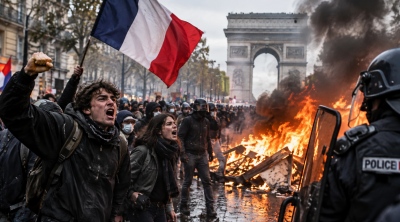
In several cities, demonstrations have led to violent clashes, with images of looted shops and burning streets dominating the media, intensifying the sense of insecurity and danger.
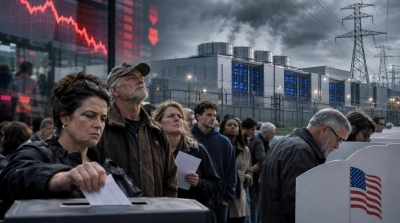
Social unrest is also impacting financial markets, reinforcing capital movement away from European bonds toward perceived safer havens, such as US government bonds.
Despite disparate national conditions, the mobilizations share a common denominator: the sensation that the political system is unable or unwilling to secure decent living conditions for the younger generation.
In Paris and Brussels, anger centers on inflation, education cuts, and the strain placed on social services.
In Madrid and Frankfurt, the housing problem sits at the core.
In Italy, young people react to low wages and the lack of professional prospects, while in Albania and Serbia corruption forms a primary cause of social discontent.
Demonstrations are no longer restricted to youth. Older age groups participate in mobilizations against economic inequalities, pollution, increases in the retirement age in France, and plans for military conscription in Germany.
Europe remains one of the wealthiest regions on the planet, possessing robust social protection institutions.
However, as explained, thousands of citizens take to the streets because they feel that this wealth no longer translates into real economic opportunities.
«For many young Europeans, the greatest fear is that they will live worse than their parents».
Economic stagnation deprives the new generation of a future
Europe remains economically powerful compared to many other regions of the world.
However, its growth rates lag significantly behind those of the United States, constraining new job creation and the ability of governments to fund social policies.
According to data from the World Bank, the real GDP of the eurozone expanded by merely 1.4% in 2025, compared to 2.2% in the United States.
The French economy contracted during the first quarter of 2026, while Germany and Italy registered only marginal growth, according to Eurostat.
The consequences are especially acute for young workers.
Youth unemployment under age 25 stands at 15.4% in the eurozone and 15.5% across the whole of the European Union, whereas in the United States the corresponding figure settles at 9.9%.
Behind these numbers stand millions of young people struggling to find stable employment, attain financial independence, and plan their future.
At the same time, European governments face mounting fiscal pressures.
They must finance pensions, healthcare, education, and housing policies, while managing massive public debts.
In France, public debt stands at 115.7% of GDP, while in Italy it reaches 136.7%.
These constraints gradually transform economic dissatisfaction into political rage.
A generation that watches social benefits shrink, the cost of living climb, and its expectations dashed begins to question not merely governmental policies, but the very system producing them.

Inflation swallows wages
One of the most significant factors behind the youth uprising is the ongoing erosion of purchasing power.
The comparison between Europe and the United States is not simple.
Americans frequently face higher direct expenses for healthcare, university studies, and housing, whereas Europeans benefit from more developed public services and subsidized education and health systems.
However, for a young worker, the true measure of economic well-being is not solely product pricing.
It is primarily the sum remaining from one's wage after paying rent, taxes, energy bills, commuting, and food.
By this benchmark, numerous European cities have become prohibitively expensive living environments for the young.
Energy costs place a heavy burden on households and businesses.
Electricity and natural gas prices remain higher than corresponding rates in the United States.
Part of this difference is attributed to the halt in cheap Russian gas supplies, difficulties in the energy transition, and stricter environmental regulations.
Concurrently, high indirect taxes elevate consumption costs.
In many European countries, VAT exceeds 20%, burdening the prices of goods and services.
In contrast, the United States has no federal VAT, while state and local sales taxes are generally lower.
For millions of young Europeans, employment no longer guarantees economic security.
A salary often suffices only to meet basic necessities, leaving no margin for savings or starting a family.

Deindustrialization and the loss of quality jobs
The economic stagnation of Europe is exacerbated by the gradual weakening of its industrial base, the offshoring of production, and elevated operating costs for European enterprises.
The production model appears to have run its course, dragging an entire generation down with it.
The automotive industry, particularly that of Germany, serves as a characteristic example.
European policies aiming for a faster transition to cleaner vehicles bolstered demand for electric and plug-in hybrid cars.
At the same time, however, Chinese automakers significantly strengthened their footprint in European markets, creating added competitive pressures for domestic manufacturers.
European companies are now called upon to adapt to exceptionally demanding competition, at a time when industrial output confronts mounting difficulties.
This development also affects prospects for young workers, curbing opportunities for stable, well-remunerated careers.
A generation trapped in the parental home.
Perhaps the most telling manifestation of the economic strain borne by European youth is the inability of young people to leave the family residence and establish their own household.
According to Eurostat, in 2025 young people in the European Union left their parental home at an average age of 26.3 years, compared to 26.2 years in 2024.
The European average has remained close to 26 years since 2002.

However, in the countries of Southern and Southeastern Europe, the situation is far more difficult.
In Greece, a young person needs to reach almost 31 years of age, on average, to acquire an independent residence.
In Finland, Denmark, Estonia, and Lithuania, conversely, young people leave the family home in their early twenties.
Rising rents and home acquisition costs, combined with the stagnation of real wages, delay economic independence and feed distrust toward the political system.
For more and more young people, the ability to live independently, build a family, or acquire a home transforms from a self-evident right into a distant dream.
Youth mobilizations have cultural roots as well
European generations grew up in consumer societies, accustomed to levels of benefits and expectations that today low-growth economies struggle to maintain.
In France, the demand for labor during the industrial era led to the creation of social housing in the suburbs.
Today, unemployment and inadequate infrastructure have turned some of these areas into zones of social exclusion and parallel societies, combined with the failure to integrate immigrant populations and the reality that social service infrastructures fall short both in quality and funding.
Even when national economies grow, many young people living in these neighborhoods see no tangible opportunities for social mobility.

The crisis is not merely economic, it is a crisis of the future itself
The young people participating in demonstrations are predominantly students, recent graduates, and workers taking their initial steps in professional life.
They react to chronic underfunding of education, crushing housing expenses absorbing a large portion of entry-level salaries, and widespread high prices.
International pressures, such as rising energy and food costs, exacerbate this discontent.
The mobilizations also serve as a warning to European governments regarding their fiscal priorities.
Education, universities, and affordable housing, namely the public investments determining the productivity and welfare of coming generations, are forced to compete with swelling military and security expenditures.
In Germany, the movement Gen Z Regelt («Generation Z Takes Charge») has incorporated into its demands opposition to mandatory military service and increased investment in education.
The message emerging from the mobilizations is that young people are no longer willing to passively accept the steady degradation of their living conditions.
«Silence and patient observation of a slow, multi-year erosion of everyday well-being will not be tolerated».

Youth challenges a system demanding ceaseless sacrifices
The uprisings sweeping through Europe bring to the surface a deeper contradiction.
The continent continues to possess enormous accumulated wealth, robust financial institutions, and a high level of technological development. Nevertheless, an expanding segment of the younger generation feels excluded from the dividends of this prosperity.
Young people are expected to work in an environment of uncertainty, pay ever-higher rents, shoulder growing tax and energy burdens, and adjust to successive economic crises.
At the same time, they observe governments invoking fiscal constraints whenever education, social protection, and housing are concerned.
Thus, discontent takes on increasingly distinct political characteristics.
The young generation does not protest solely because it struggles to get by today. It revolts because it fears tomorrow will be even worse.
For European leaderships, the challenge is exceptionally severe.
Many demands of protesters require public resources that governments struggle to secure, reforms that meet political resistance, and higher growth rates that Europe has been unable to attain for years.
The issue, therefore, is not limited to managing isolated demonstrations or temporary social tensions.
It concerns the capacity of the European political and economic model to deliver a credible prospect to coming generations.
And as long as this prospect remains absent, more young people will turn against the establishment they hold responsible for their economic asphyxiation.
European youth sends a clear message: it is not prepared to accept as normal a future of permanent austerity, depressed wages, inaccessible housing, and constrained opportunities.
A generation raised on the promise that it would live better than the previous one discovers it risks becoming the first to live worse. And this disillusionment now feeds and expands into rage across the streets of Europe.
www.bankingnews.gr











Σχόλια αναγνωστών